A Busy Employee Relations Team Is a Symptom
Article by: Donovan Parish
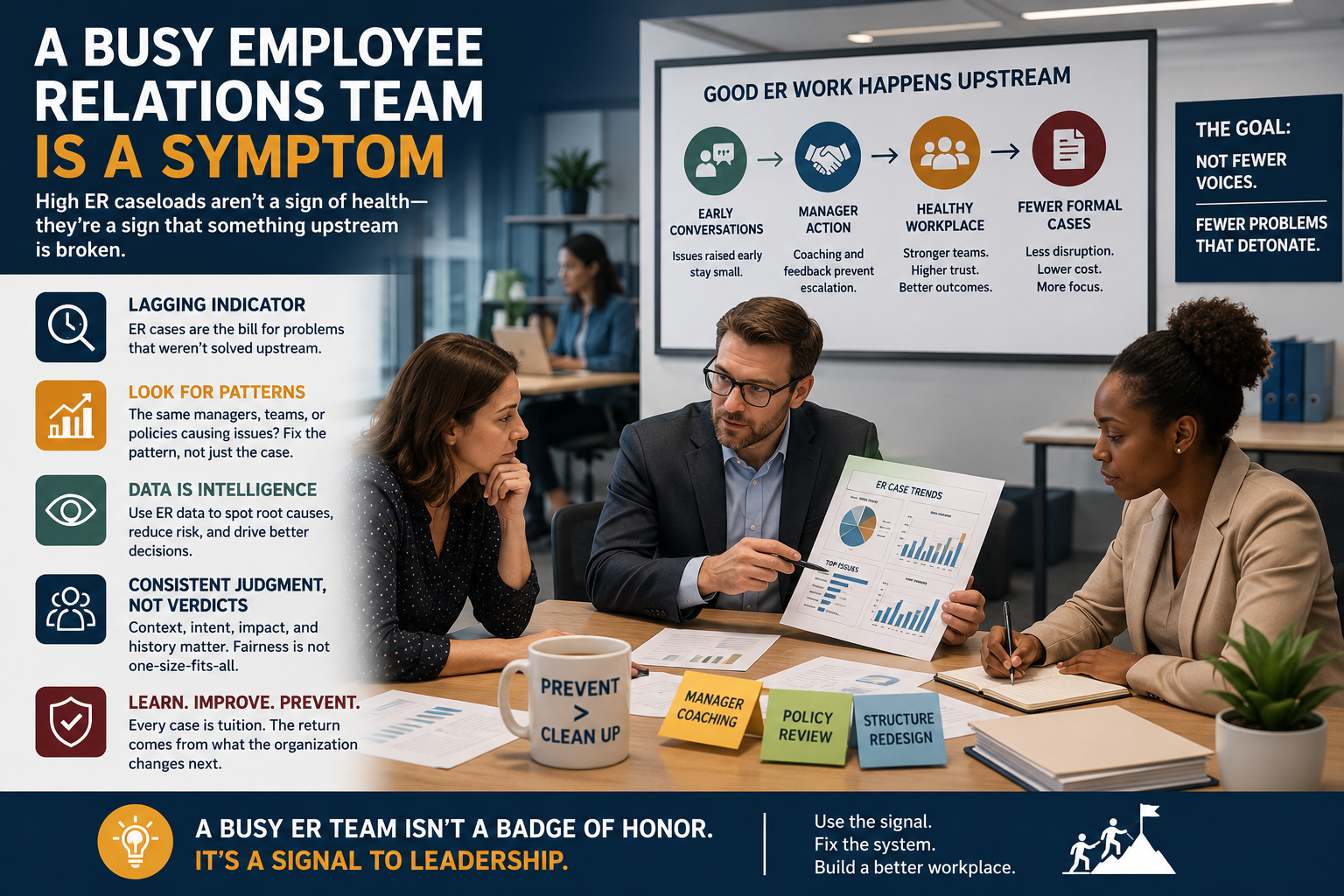
Most organizations read a productive employee relations function as a sign of health. It is the opposite. A high volume of cleanly resolved ER cases is not evidence that HR is working. It is evidence that something upstream is broken, and that the organization has gotten efficient at paying for it.
One caution before the argument, because it is easy to misread. The goal is not fewer people raising concerns. A healthier organization often surfaces more early, because people feel safe naming things while they are still small. The goal is fewer concerns that detonate into formal cases. Raised early is the system working. A grievance, an investigation, a separation: that is the bill for something that was not handled in time.
An ER case is a lagging indicator. By the time a matter reaches that stage, the failure already happened, usually weeks earlier, usually as a conversation a manager chose not to have. Take the manager who lets three months of missed deadlines slide because the conversation feels awkward, then comes to HR once it is a performance problem with a paper trail. The investigation, the documentation, the resolution: all of it is cleanup, and the cost was incurred long before the file was opened.
Follow that and it gets uncomfortable. Organizations with strong managers resolve most friction before it ever becomes ER work. A function buried in formal cases is usually a function cleaning up for managers who are failing upstream at scale, and HR has often become so capable at the cleanup that no one feels pressure to stop creating the work. The function gets excellent at something that should barely need to exist. Then leadership grades it on throughput and resolution time, which is a little like grading a smoke detector on how fast it puts out fires while never asking why the building keeps catching.
This is where most organizations get employee relations wrong, and few will say it out loud. The case is not the product. The pattern is.
Treat each complaint as an isolated event to close, and you optimize for the wrong outcome. The same handful of managers keep generating grievances. The same team keeps losing its strongest people after every reorg. The same policy keeps producing the same dispute at the same point in every cycle. Each case gets resolved, on time, and the mechanism producing them runs untouched. That is not managing risk. It is absorbing it and reporting the absorption as service.
The data inside an ER function is some of the most decision-useful intelligence a company has, and most companies waste it. Resolution rate and time-to-close are vanity metrics; they measure how fast HR cleans up, not what keeps requiring it. The questions that create value are different. Which managers generate disproportionate volume for their headcount. Which structures put people into conflict no mediation will resolve. Which policies read fine on paper and detonate in practice. Where conflict clusters tells you where execution is about to break, which integrations are failing, and which leaders cannot scale. Read correctly, ER caseload is an early-warning instrument. Read incorrectly, it is just a queue.
There is a deeper reason the upstream conversation never happens. Managers rarely avoid it out of laziness. They avoid it because most workplaces quietly reward looking fine over being honest. People present the version of themselves they think the organization wants, problems get managed for appearance rather than named, and a formal case is often just what happens when that performance finally breaks down.
So what does good look like. Not a faster intake process or a better case-management tool. Good employee relations is wired directly into leadership development and organizational design, and it treats every case as tuition the company has already paid. The spend is sunk. The only return left is whether the organization learns the lesson it just bought and routes it to the manager who needs coaching, the structure that needs redesign, or the policy that needs rewriting.
First, HR is not neutral. It cannot be, and pretending otherwise is the real liability. HR is funded by the organization, accountable to it, and exists to protect it, including from itself. An employee promised a neutral party who then collides with that reality does not just lose a case. They lose their trust, and they are correct to.
But the answer is not the other reflex the profession reaches for, which is consistency. Said the way most people hear it, consistency means the same outcome for the same surface-level act, regardless of who did it. That is not fairness. It is automation, and it is the rulebook a manager hides behind to treat a five-year high performer having one bad quarter exactly like a serial problem, then call the unfairness a principle. Two people can do the apparently same thing and deserve to land in very different places.
What HR actually owes is consistent judgment, not consistent verdicts. The same rigor applied to every case: tenure, track record, context, intent, impact, and pattern all genuinely weighed, every time. What can never vary is the integrity of the analysis. What should almost always vary is the conclusion, because the situations are not the same. That is harder than treating everyone identically, which requires no judgment at all. Looking at a situation in its totality and still landing somewhere you can defend on the merits is the actual work, and it is the work most people avoid because pointing at the policy is easier.
Second, good employee relations frequently ends with no one satisfied. The employee stays unhappy, the manager stays frustrated, and the decision stands anyway. The profession has quietly absorbed the idea that a well-handled matter is one where everyone feels heard, so it measures the work by how people feel at the end of it. That is the wrong scoreboard. The objective was never comfort. It was a decision you can defend as fair, delivered cleanly, knowing the person it lands on will never agree with it.
None of this argues for a smaller HR team or a quieter one. It argues for measuring the right thing. A rising count of formal cases is not proof of effort. It is the organization telling you, in the only language it has, where it is losing capability. The work is to trace the signal back to the manager, the structure, or the policy generating it, and fix the cause.
Which is, finally, why I do this work. I want to build environments where people show up as their whole self, and that phrase gets misread constantly. Whole self does not mean unfiltered, pajamas on, saying whatever you feel. That is just a different costume, performing relaxed instead of performing polished. The distinction that matters is the filter versus the mask. A filter is judgment: choosing how and when to raise something, reading the room, giving hard feedback in a way a person can use. That is EQ, and it stays. A mask is concealment: nodding in the meeting and venting in the parking lot, saying you are fine while the project burns, performing an agreement you do not have. Whole self is the filter without the mask. Real judgment, real accountability, real investment, delivered as yourself, without fear that honesty ends your career. Not lower standards. Higher ones. A workplace full of masks does not stay quiet. It stays quiet right up until it detonates, because the truth had nowhere to go. A workplace where people keep the filter and drop the mask hears the hard thing while it is still just a conversation. Read the symptom. Then go build the place where fewer of them ever start.