The Listening Gap: How to Build Employee Feedback Systems That Actually Change How Organizations Work
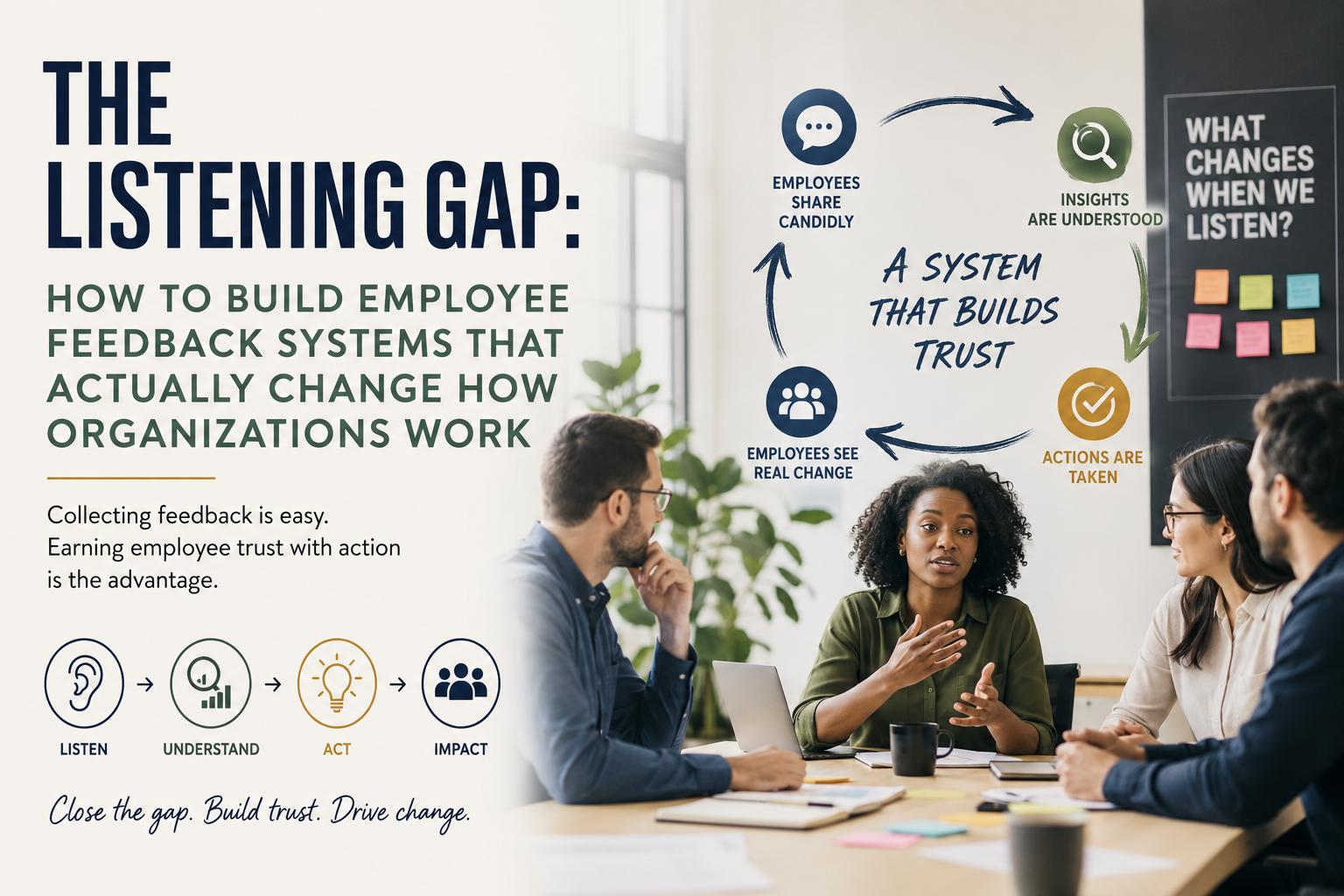
Most organizations are drowning in employee data and starving for employee insight. They run the annual engagement survey, maybe a pulse or two, collect thousands of data points, generate a deck full of color-coded heat maps, present it to leadership, and then watch almost nothing change. The next year they do it again. The scores move a point or two, nobody can say exactly why, and the whole exercise quietly reinforces the thing employees suspected all along: that nobody was really going to do anything with what they said.
I want to talk about how to break that cycle. Not with a better survey tool. Not with a more sophisticated dashboard. With a fundamentally different way of thinking about what employee listening is actually for.
Here is the uncomfortable truth at the center of this work. The problem was never that organizations could not collect feedback. The problem is that collecting feedback and acting on feedback are two completely different organizational capabilities, and most companies have invested heavily in the first while building almost nothing of the second.
I have spent fifteen years inside this problem. I have built listening systems for organizations with active collective bargaining agreements, where the gap between what employees said and what the organization did had real labor relations consequences. I have run feedback loops inside a global product and engineering organization where the volume of signal was enormous and the challenge was separating the meaningful from the noise. What I have learned is that highly engaged employee listening is not a survey practice. It is an organizational design discipline. And the organizations that figure this out are going to have a structural advantage in a labor market that keeps shifting underneath everyone's feet.
Why Most Listening Programs Fail Before They Start
Walk into almost any mid-to-large organization and ask about their listening strategy and you will hear about their survey. The annual engagement survey. Maybe a quarterly pulse. They will tell you their participation rate, their score, and how they benchmark against their industry.
What they will almost never be able to tell you is what changed last year as a direct result of what employees said.
This is the failure mode, and it is nearly universal. Organizations treat listening as a measurement activity when it is actually a trust activity. The survey is not the product. It is the opening move in a conversation, and a conversation where only one party ever speaks is not a conversation.
Here is what happens psychologically inside an organization that listens without acting. The first year, participation is high and the feedback is rich because employees believe their input might matter. They tell you real things. Then they watch. And when the answer is that a deck got presented and a few vague commitments got made and nothing in their daily experience actually shifted, they recalibrate. The next year participation drops. The feedback gets shallower, more guarded. That is the trust signal screaming at you. People stop telling you what they actually think because they have learned that telling you costs them effort and changes nothing.
By year three you have trained your workforce to give you exactly the kind of feedback that is least useful: safe, surface-level, and disengaged. Then leadership looks at the declining participation and concludes that employees do not care about engagement, when in fact employees learned precisely the lesson the organization taught them.
The participation rate is not measuring engagement. It is measuring whether employees believe you will do anything with what they say. That is the first thing I work to change when I come into an organization. Not the instrument. The relationship.
Listening Is a System, Not an Event
The single most important shift I help organizations make is moving from listening as an event to listening as a system.
An event has a beginning and an end. The annual survey opens, employees respond, it closes, a presentation happens, and everyone goes back to their actual jobs until next year. A system is continuous. Signal comes in constantly through multiple channels, gets interpreted on an ongoing basis, feeds into decisions as they are being made, and produces visible action employees can connect back to what they said.
That difference is the difference between a program that builds trust and one that erodes it.
A real system requires channel diversity. The annual census is the comprehensive measurement, the thorough physical exam once a year, valuable for its completeness and comparability rather than its score. Pulse surveys are the more frequent vital signs, short and targeted, tracking movement on the variables that matter most. Lifecycle surveys capture the high-stakes transition moments, the first ninety days, a promotion, a manager change, the exit, which are dramatically underused and produce some of the richest signal you will ever get. A new hire at day forty-five sees things with fresh eyes that longtime employees have lost. And the always-on channels, open feedback, manager one-on-ones, skip-levels, employee resource groups, are where listening stops being a survey practice and becomes an organizational capability.
No single channel tells you the truth. The truth emerges from the pattern across channels. When the census, the pulse data, the exit interviews, and the manager conversations all point the same direction, you have found something real. When they conflict, the conflict itself is information.
When I build a system, I do not turn on every channel at once. I sequence them based on what the organization can actually handle, usually starting with a strong census to establish the baseline, then layering in targeted pulses, then lifecycle surveys, then the always-on channels as capability and trust mature. Turning everything on at once generates more signal than a low-trust organization can process and act on, which brings you right back to the listening gap.
The Analytics Discipline: Turning Messy Data Into Real Signal
Let me be direct about something that does not get said enough. Most of what passes for people analytics is decoration, not decision support. It is a dashboard that looks impressive and changes nothing. It is fake precision, numbers to two decimal places to create the impression of rigor while obscuring a methodology that cannot support the conclusions being drawn.
Real people analytics is different, and the difference starts with what you are actually measuring and why. When I analyze listening data, I am not trying to produce a number. I am trying to answer a question, almost always some version of this: where is the system failing people, and what would it take to fix it? The engagement score is not the destination. It is a symptom, and the job is to diagnose the underlying condition.
The first analytical move is disaggregation. The aggregate score is almost useless for action because it averages away the texture that matters. An organization at seventy-two percent might have a uniformly mediocre experience, or a phenomenal one in some teams and a catastrophic one in others that average to seventy-two. Those are completely different organizations requiring completely different interventions. Break the data down by manager, tenure, function, location. When you discover that the variance between your best and worst managers is enormous, you have located the problem. The aggregate told you the organization had room to improve. The disaggregation told you exactly where and exactly who.
The second move is connecting sentiment data to outcome data. Engagement scores in isolation are interesting but not actionable. Connected to attrition, performance, internal mobility, and productivity, they become a business case. When I can show that the teams with the lowest psychological safety are also the teams with the highest regrettable attrition, and that the cost is quantifiable and significant, I have transformed a soft HR metric into a hard operational signal with a dollar figure attached. That is the work that earns HR a seat at the table where decisions actually get made.
The third move, and the most sophisticated, is identifying leading indicators rather than lagging ones. Attrition is a lagging indicator. By the time someone shows up in your turnover data, the decision was made months earlier. The real value is in the early signals that predict the outcome while there is still time to intervene: declining one-on-one frequency, dropping participation in optional activities, a shift in the language people use in open-ended responses, a decline in internal mobility applications from a particular team. These give you the thing that matters most, which is time.
This analytical work does not happen through a survey platform's built-in reporting, which is designed to make the data look good, not to support hard decisions. The real analysis happens when you take the data out of the platform and interrogate it properly, connecting it to your HRIS and performance and attrition data, running the disaggregation the platform does not offer by default. Increasingly I do parts of this with AI-augmented workflows when they can be leveraged, processing large volumes of qualitative feedback and surfacing thematic patterns across thousands of open-ended responses that would take weeks to find manually. But the AI does not do the thinking. It accelerates the synthesis. The judgment about what the patterns mean remains human work, and it remains the most important part of the entire process.
From Insight to Action: The Translation Almost Nobody Does
This is the part that separates organizations that build trust from organizations that erode it. Most are not bad at collecting data. Many are not even bad at analyzing it. Where they fail, almost universally, is the translation. They generate insight and do not convert it into change. The insight sits in a deck while the employees who provided it watch and learn that their input did not matter. That is the listening gap, the gap between collecting and acting.
Closing it rests on three principles.
First, action must be specific, owned, and time-bound. Vague commitments are worse than none, because they signal that the organization wants credit for responding without being accountable for change. "We will focus on improving communication" is a non-commitment. Real action looks different: we found that new hires lack clarity on what success looks like, so we are implementing a structured thirty-sixty-ninety day expectation framework co-created between every new hire and their manager before day one, owned by this specific leader, in place by this date, measured over the following two quarters. That is something you can hold someone accountable to, and something employees can connect back to what they said.
Second, you cannot act on everything, and trying to is its own failure mode. Rich feedback surfaces dozens of problems. Chase all of them and you solve none of them well. The discipline is prioritization weighed against feasibility, and the courage to focus. One of the most trust-building things an organization can do is come back to employees and say: you told us ten things, here are the three we are tackling first and why, and here is our honest thinking on the timing for the rest. That transparency builds more trust than a scattershot attempt to fix everything.
Third, and this is what makes the whole system work, close the loop visibly. The most important moment in a listening cycle is not the survey or the analysis. It is when the organization comes back and says: here is what you told us, here is what we are doing, and here is how you will know whether it worked. This is the single most neglected step in almost every organization I have worked with. They run the survey, analyze it, make decisions, and never draw the line from employee input to the resulting change, so even when they do act, employees never realize it. I build loop-closing in as a non-negotiable. Every cycle ends with a visible, specific communication: you spoke, we listened, here is what changed. Then the next cycle begins, and employees who saw that their input mattered engage more deeply. That is the virtuous cycle. That is what highly engaged listening actually means.
The Trust Equation, and the Bespoke Approach
Everything above rolls up into one outcome: trust between employees and the leaders who run the organization. Not engagement scores. Not participation. Trust.
Every time an organization asks for feedback, it makes an implicit promise that your input matters and we will do something with it. Keep that promise and you make a deposit in the trust account that pays dividends in every direction: higher quality feedback, greater discretionary effort, lower regrettable attrition, a stronger employer brand. Break it and you do not just fail to build trust, you actively destroy it. Asking and then ignoring is worse than never asking, because it signals either that leadership does not care or cannot act. An organization not prepared to act on what it learns is better off not asking. The survey is not a neutral instrument. It is a promise, and promises have consequences whether you keep them or break them.
This is also why I work the way I do. The dominant model in the market is the platform model: buy a tool, run its templates, read its dashboards, follow its best practices. The platforms are genuinely useful for collecting and storing feedback. But a platform cannot understand your organization. It gives you the same survey, the same benchmarks, the same generic best practices it gives everyone else, and generic listening produces generic results. The hard part was never the data collection the platform handles. The hard part is the interpretation and the action, and those are inherently specific to your culture, your leadership, your history, and the structural realities that determine what action is even possible.
My approach is bespoke. I do not come in with a template. I come in to understand the organization first. What is the history here? Has this organization listened before, and what happened? What is the level of trust right now, and what created it? What are the structural realities, the union dynamics, the functional cultures, that shape both what employees say and what the organization can do about it? Only then do I design the system, tailored to that specific reality. That is more work than running a platform's templates. It is also dramatically more effective, because it solves the actual problem rather than the one the platform was built for. I think of myself less as a survey administrator and more as an organizational diagnostician. The listening system is the instrument. The value is in the diagnosis and the treatment plan.
What This Looks Like When It Works
When listening works, an employee with a concern, an idea, or a frustration has a real channel to express it, and they use it because they have learned that expression leads somewhere. The signal flows into a system that processes it with rigor, finds the pattern it belongs to, and surfaces it to the people who can act. Those people make a real decision, owned and time-bound, because the data gave them a clear picture of a real problem. The action happens. The employee sees it happen. And the organization comes back and says, explicitly: you told us this, and here is what we did.
That is trust being built, transaction by transaction. And it compounds. An organization that runs this loop well for years has a workforce that trusts leadership, a leadership team that gets honest signal, and an institutional capability to adapt that competitors cannot easily replicate. The engagement scores, where most organizations start and stop, are just the surface indicator of something much deeper.
This is the work. It is not a survey, a dashboard, or a platform. It is the deliberate construction of an organizational capability to sense and respond to the people who do the work, built on trust, powered by analytical rigor, and focused relentlessly on translating insight into achievable action. Because an organization that truly listens, and truly acts on what it hears, is one where people can do their best work. Not despite the systems around them, but because of them.
And in the end, that is what all of this is for.
Drew Soule is an HR executive and people operations strategist who helps organizations build employee listening systems that translate data into action and build trust between employees and leadership. He writes about people operations, organizational design, and the future of HR at drewsoule.net and through The Practitioner Files at thepractitionerfiles.com
